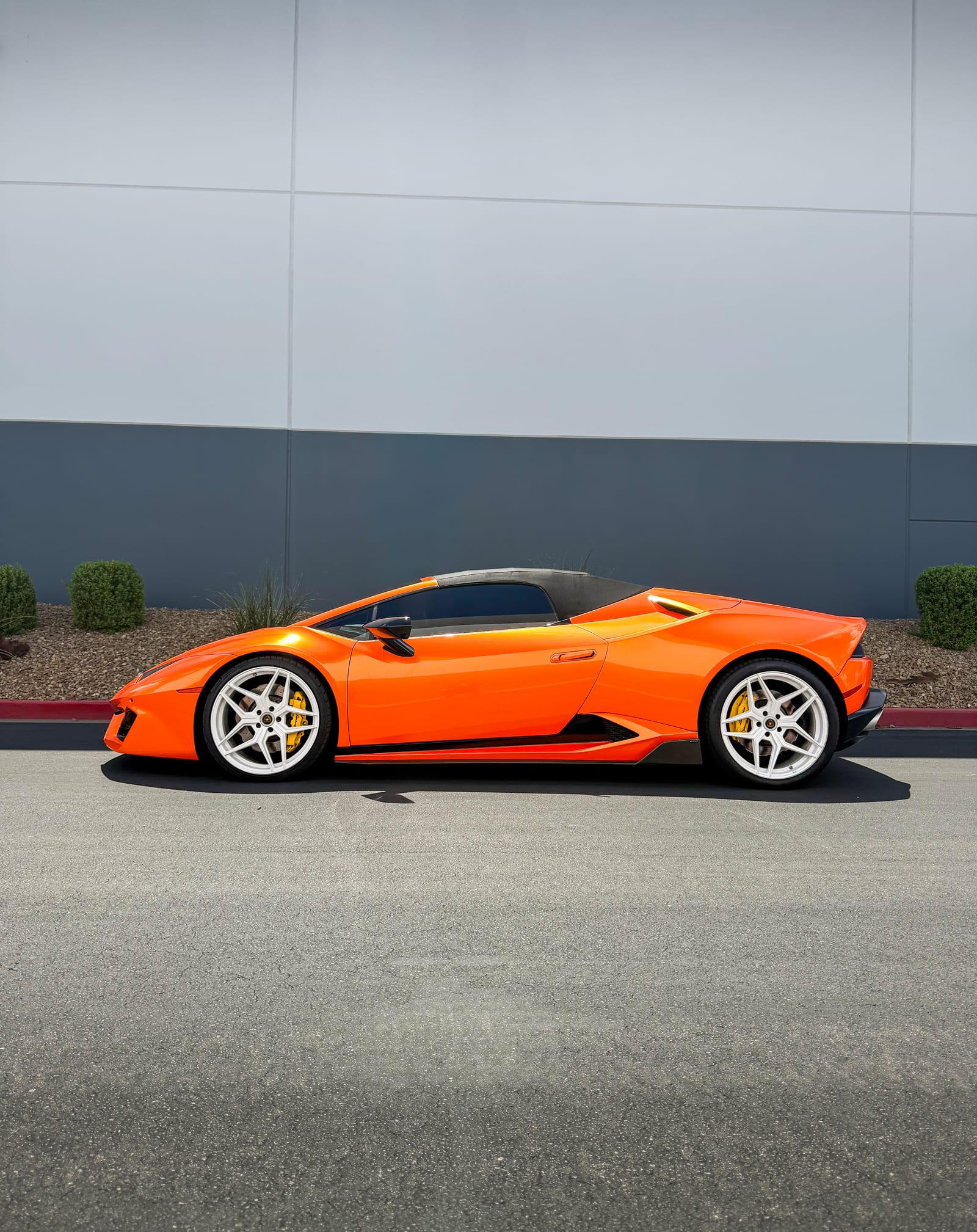
An orange car wrap is one of the most rewarding color choices you can make — and one of the easiest to get wrong. A gloss orange Lamborghini Huracan Spyder that came through our Henderson facility is a good real-world example of what separates a color that looks flat from one that looks genuinely expensive.
Orange is unforgiving because it sits so close to traffic-cone territory. A cheap or poorly saturated orange reads as safety equipment. A well-chosen, deeply pigmented orange does something different: it shifts. On this Huracan, the gloss finish pulls warm gold and amber highlights across the hood, front fenders, and door shoulders as the light moves. That shift — from orange to almost bronze and back — is what tricks the eye into reading depth instead of flat color, and it’s the difference between a wrap that looks like a decal and one that looks like it belongs on the car.
Why an Orange Car Wrap Is Deceptively Hard to Get Right
Depth in a color comes from how it handles light, not just what the swatch looks like under fluorescent showroom bulbs. Nevada daylight is intense and directional — it’s a completely different test than a sample viewed indoors or a photo on a phone screen. Colors that look punchy inside can go chalky outside, and colors that look muddy inside can come alive once real sun hits them.
That’s why, if you’re seriously considering an orange car wrap, you should always ask to see a physical sample outdoors, in direct sun, at the angle your car will actually be parked or driven. A screen or a showroom light will lie to you. The desert sun won’t.
Gloss, Satin, or Matte in Orange
- Gloss maximizes the highlight shift described above — it’s what gives this Huracan its warm, almost metallic movement across the body panels.
- Satin softens that shift into a smoother, more even glow, with less hard reflection.
- Matte flattens the highlights entirely, trading depth for a bold, graphic look that reads more like a solid block of color from any angle.
None of these is objectively better — it depends on whether you want the color to move with the light or hold still.
Pairing a Bold Color With What’s Already on the Car
A loud primary color doesn’t exist in isolation. It has to work with the wheels, calipers, and any other accent colors already on the vehicle. Bright wheel finishes and colored calipers can either complement a bold wrap or compete with it, so it’s worth looking at the whole car together — not just a swatch against bare metal — before committing to a shade. This is part of why we always recommend seeing full vehicle mockups or in-person samples rather than judging a color in a vacuum.
Reversible Commitment: The Practical Case for Bold Color
One of the most underrated advantages of a vinyl color change wrap is that it’s reversible — and if you’re weighing the alternatives, our breakdown of color PPF vs vinyl wrap covers that trade-off. A color this loud is a low-commitment choice compared to a repaint — if your taste changes, or you decide to sell the car, the wrap can be removed and the factory paint underneath is protected the entire time it’s been on. That reversibility is exactly what makes an orange car wrap a smart way to experiment with a color you’d never commit to in paint.
Living With a Bright Wrap in the Desert
Bright, saturated colors show contamination more than muted ones, and Southern Nevada throws a lot at a vehicle’s finish — UV, heat, and road debris. A few habits keep a color-change wrap looking sharp:
- Hand wash rather than automatic tunnels with abrasive brushes.
- Remove bird droppings and tree sap promptly — they can etch or stain vinyl if left in the heat.
- Park in shade or covered parking when possible to reduce UV exposure and surface temperature swings.
These same principles apply to every one of our Las Vegas car wraps, whether the car sits in daily traffic or stays garaged as a weekend toy. If you want a color this bold to actually last and look good years down the road, pairing it with a ceramic coating is worth discussing.
For high-value or exotic vehicles specifically, it’s also worth understanding how a full paint protection film layer interacts with a color change — PPF is like a jacket, and ceramic coating is like sunscreen, and a wrap can sit on top of or alongside either depending on your goals. Material choices are backed by industry standards from manufacturers like 3M, which is worth researching before you commit to a finish.
If you’re weighing an orange car wrap — or any bold color — for your own vehicle, stop by our Henderson wrap shop across from Lamborghini Henderson. We keep physical samples on hand so you can see how a color actually behaves in real Nevada daylight before you commit.
Gallery